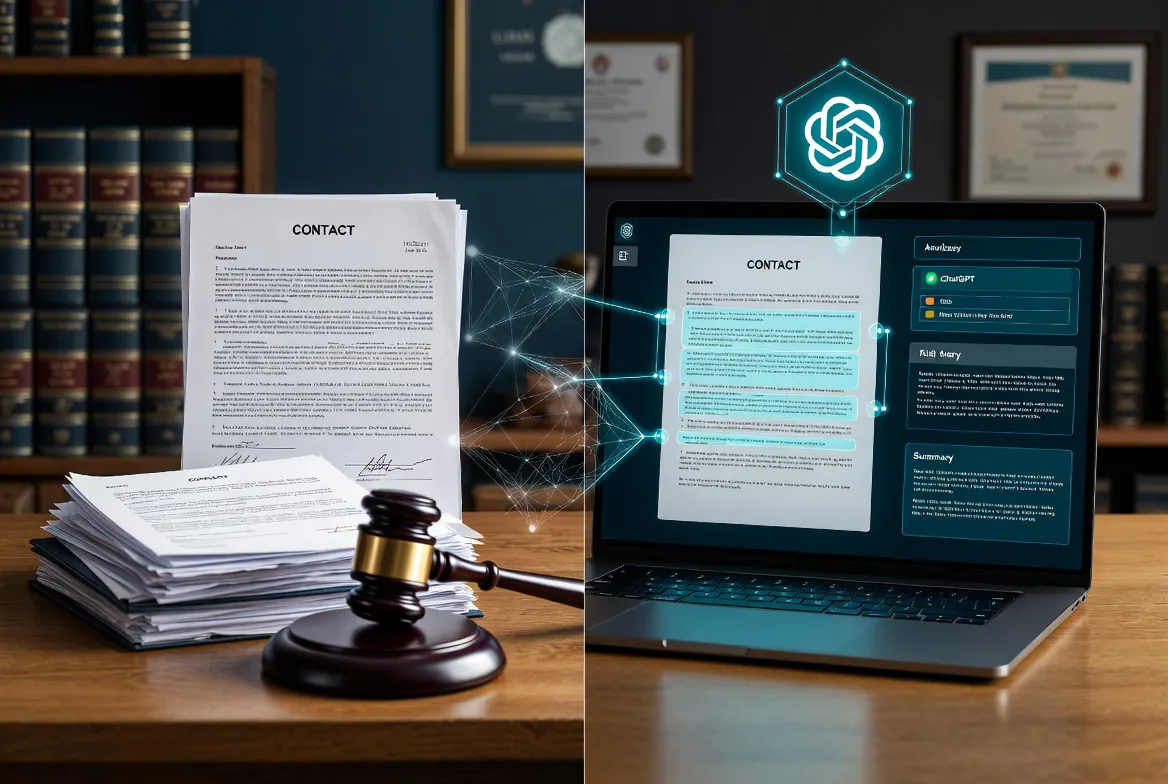
As a former solicitor who has navigated the complexities of contract law for over a decade, I've witnessed firsthand the relentless pressure on legal professionals to deliver faster, more accurate, and cost-effective services. The digital age has brought forth an unprecedented wave of technological innovation, and nowhere is its impact more profound than in the realm of legal technology. Specifically, AI contract review is no longer a futuristic concept but a present-day reality, offering transformative potential for UK solicitors.
This comprehensive guide delves into how Artificial Intelligence (AI) is reshaping contract review processes across the UK legal landscape. We'll explore the tangible benefits, operational mechanics, and critical considerations for integrating AI into your practice, whether you're a partner at a Magic Circle firm or a sole practitioner.
The Evolving Landscape of UK Contract Law and the Need for AI
The UK legal sector, governed by bodies like the Solicitors Regulation Authority (SRA), demands meticulous attention to detail, especially in contract law. Traditional contract review is a labour-intensive, often repetitive task, prone to human error, and a significant drain on billable hours. From due diligence in M&A transactions to routine commercial agreements, the volume and complexity of contracts continue to grow.
"I reviewed a 47-page distribution agreement using Harvey last year — the kind of contract I would normally spend four hours on. Harvey flagged 23 clauses for attention, 19 of which I would have flagged myself. The four it missed were genuinely subtle — one was a jurisdiction clause that only became problematic in context of a side letter. That's the honest picture: AI is a very good first pass, but it is not a replacement for a solicitor who understands the deal."
My own experience, particularly during large-scale corporate transactions, involved countless hours poring over documents, identifying clauses, and flagging anomalies. This is precisely where AI steps in — not to replace the solicitor's critical judgment, but to augment their capabilities, freeing them to focus on higher-value strategic advice.
What is AI Contract Review?
AI contract review refers to the use of artificial intelligence technologies, primarily machine learning and natural language processing (NLP), to analyse legal documents. These systems are trained on vast datasets of contracts to identify, extract, and summarise key information, flag risks, ensure compliance, and compare documents against precedents or playbooks.
How AI Contract Review Works: The Process and Technology
At its core, AI contract review operates through several sophisticated technological layers:
1. Data Ingestion
The AI system first ingests contracts, often in various formats (PDF, Word, scanned images). Optical Character Recognition (OCR) converts images into searchable text.
2. Natural Language Processing (NLP)
NLP algorithms then 'read' and understand the text, identifying clauses, entities (parties, dates, values), and their relationships. This is far more advanced than simple keyword searches; NLP comprehends context and meaning.
3. Machine Learning (ML)
ML models, particularly supervised learning, are trained on annotated datasets of contracts. For example, a model might learn to identify a 'change of control' clause or a 'limitation of liability' clause. The more data it processes and the more human feedback it receives, the more accurate it becomes.
4. Pattern Recognition and Anomaly Detection
The AI identifies patterns, extracts specific data points, and flags deviations from standard clauses, missing clauses, or potentially problematic language based on pre-defined rules or learned behaviours.
5. Risk Scoring and Reporting
Many platforms provide risk scores for contracts or specific clauses, generating reports that highlight areas requiring a solicitor's attention, often with suggested revisions or explanations.
Real-World Example
During a recent project involving a client's portfolio of supplier agreements, an AI tool was able to identify all instances of indemnification clauses and their specific wording across 200 contracts in under an hour — a task that would have taken a junior solicitor days. This allowed the team to quickly assess the client's risk exposure and advise accordingly.
Benefits of AI in Contract Review for UK Solicitors
Enhanced Efficiency and Speed
AI can review hundreds of pages in minutes, dramatically reducing the time spent on initial document analysis. This accelerates transaction timelines and allows solicitors to take on more matters.
Improved Accuracy and Consistency
By automating the identification of clauses and risks, AI minimises human error and ensures a consistent application of review standards across all documents. This is particularly crucial for compliance with regulatory bodies like the SRA.
Cost Reduction
Reduced review times translate directly into lower operational costs for firms and potentially lower fees for clients, making legal services more accessible and competitive.
Risk Management
AI excels at identifying hidden risks, non-compliant clauses, or missing provisions that a human might overlook, bolstering a firm's risk management strategy.
Compliance
For sectors with stringent regulatory requirements, such as financial services or data protection (e.g., GDPR), AI can ensure contracts adhere to the latest legal standards and internal policies.
Focus on High-Value Work
By automating routine tasks, solicitors can dedicate more time to complex legal analysis, client strategy, and business development, enhancing job satisfaction and client relationships.
Addressing Specific UK Regulatory Compliance Challenges with AI
UK solicitors operate within a complex regulatory framework. AI can be particularly valuable in navigating these specific challenges:
| Regulatory Area | How AI Helps |
|---|---|
| UK GDPR / Data Protection Act 2018 | Identifies and flags clauses related to data processing, data sharing, and data subject rights |
| Consumer Rights Act 2015 | Verifies that B2C contract terms relating to goods, services, and digital content meet statutory standards |
| Competition Law | Identifies clauses that might raise concerns under UK competition law, such as restrictive covenants or market-sharing provisions |
| Financial Services Regulation (FCA) | Ensures contracts align with FCA rules and other relevant financial regulations |
| ESG Compliance | Identifies and tracks ESG-related clauses in supply chain agreements or investment contracts |
Leading AI Contract Review Platforms in the UK Market
The market for legal tech is burgeoning, with numerous AI contract review platforms available. Here's a general overview of prominent players often used by UK firms:
ContractPodAi
UK-FoundedA UK-founded company, offering end-to-end contract lifecycle management (CLM) with strong AI review capabilities. Known for its comprehensive suite and enterprise-level solutions.
Kira Systems
Market LeaderA market leader, widely adopted by large law firms globally, including many in the UK. Renowned for its powerful machine learning and ability to identify complex clauses.
ThoughtRiver
UK-BasedAnother UK-based company, focusing on pre-signature contract review. It uses a 'contract risk engine' to provide immediate risk assessments, often integrated into drafting workflows.
Luminance
Cambridge-DevelopedDeveloped by specialists from the University of Cambridge, Luminance focuses on rapid due diligence and discovery, using unsupervised machine learning to highlight anomalies.
Cost-Effectiveness and ROI of AI for Legal Practices
Implementing AI contract review involves an initial investment, but the return on investment (ROI) can be substantial. My observations from working with firms adopting AI suggest several areas of significant financial benefit:
Integrating AI Tools into Existing Legal Workflows
Successful AI adoption isn't just about buying software; it's about seamless integration into existing workflows and a cultural shift within the firm. I stress the importance of a phased approach:
- 1.Pilot Project: Start with a specific practice area or type of contract where the benefits are clear and measurable (e.g., NDAs, specific due diligence tasks).
- 2.Training and Change Management: Provide comprehensive training for all users. Emphasise that AI is a tool to assist, not replace, fostering a positive attitude towards technology. Appoint 'AI champions' within the firm.
- 3.Workflow Mapping: Analyse current contract review workflows and identify points where AI can be introduced to automate or accelerate tasks. AI can perform the first pass, highlighting key clauses, which a solicitor then reviews and refines.
- 4.Feedback Loop: Establish a system for users to provide feedback to the AI. This human-in-the-loop approach helps the AI learn and improve its accuracy over time, especially for firm-specific nuances.
- 5.Iterative Expansion: Once successful in a pilot, gradually expand AI use to other practice areas or contract types.
- 6.Data Governance: Implement clear policies for data input, storage, and output to ensure compliance with SRA rules and data protection regulations.
Ethical Considerations and Limitations of AI in Law
While AI offers immense potential, solicitors must be acutely aware of its ethical implications and limitations. The SRA's principles of acting with integrity and in the best interests of clients remain paramount.
⚠️ Bias
AI models are only as good as the data they are trained on. If training data contains historical biases, the AI may perpetuate them. Solicitors must be vigilant in reviewing AI outputs for fairness and impartiality.
⚠️ Accountability
Who is responsible if an AI makes an error that leads to a client loss? Ultimately, the solicitor remains accountable for the advice given and the documents signed. AI is a tool, not a decision-maker.
⚠️ Confidentiality and Data Privacy
Handling sensitive client data requires robust security measures. Firms must ensure AI vendors comply with UK GDPR and maintain strict confidentiality. Data residency is a key consideration.
⚠️ The 'Black Box' Problem
Some advanced AI models operate as 'black boxes,' making it difficult to understand their decision-making process. This can be problematic in a profession built on transparency and reasoned judgment.
⚠️ Limitations of AI
AI cannot exercise legal judgment, understand nuanced client relationships, or navigate complex ethical dilemmas. It lacks empathy, creativity, and the ability to negotiate. It is a tool for analysis, not for providing legal advice.
Future Trends in AI and Legal Services in the UK
The trajectory of AI in the UK legal sector points towards deeper integration and more sophisticated applications. Within the next 5–10 years, I anticipate AI contract review will become a standard tool in most UK law firms, much like word processors are today. Key emerging trends include:
- →Predictive analytics to forecast litigation outcomes and assess contractual risks
- →Generative AI for drafting initial contract clauses with solicitor review and refinement
- →Hyper-personalisation of legal services based on deep analysis of client-specific data
- →Blockchain integration for self-executing 'smart contracts' with AI-verified legal validity
- →SRA regulatory sandboxes to encourage and safely test innovative legal tech solutions